Ever felt a bump on your face or neck,
and pressed on it thinking it was just a pimple?
Then had blood and pus suddenly burst out, catching you completely off guard?
More people go through this than you’d expect.
A cyst that isn’t removed at its root tends to fill back up over time,
often leaving behind an even larger scar.
Today we’re covering what causes a sebaceous cyst to form,
and the proper way to have one removed while minimizing scarring.

In this article, we’ll look at what actually causes a sebaceous cyst to form and how it differs from acne,
then walk through the excision techniques used to help reduce scarring during sebaceous cyst treatment.
We’ll also cover the principle behind removing the cyst wall to help lower the chance of recurrence, and why self-extraction carries risk.

What Is a Sebaceous Cyst?
A sebaceous cyst is a benign, sac-like growth that forms when sebum builds up beneath the skin.
A sebaceous cyst forms when the opening of an oil gland becomes blocked, trapping sebum and dead skin cells beneath the skin instead of letting them drain normally, which creates a sac.
As trapped sebum accumulates, it forms a larger sac under the skin,
and because it keeps filling with more sebum, it can feel like a soft or firm lump to the touch.

Completely removing the cyst sac is generally necessary to help reduce the chance of recurrence.
Draining only the contents tends to be a temporary fix, not a lasting solution.
A cyst may start out feeling soft, but it can gradually become firmer over time.
Rather than pressing on it yourself, getting an accurate diagnosis first is the safer approach.
How Is a Sebaceous Cyst Different From Acne?
Acne is inflammation near the top of a pore, while a sebaceous cyst is a sac that forms deep in the dermis — so the two conditions differ from the root cause up.
Typical acne involves pus-filled inflammation near the upper part of a pore, while a sebaceous cyst involves a sac that forms deep within the dermis.

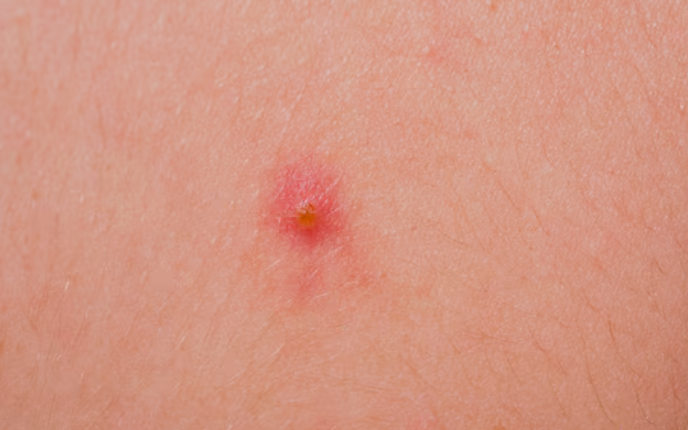
| Category | Acne | Sebaceous Cyst |
|---|---|---|
| Location | Upper pore | Sac deep in the dermis |
| When squeezed | Only the upper portion of the oil gland drains | Sebaceous material can leak from a tiny central opening |
| If left untreated | Scarring risk is relatively low | If infected, the scarred area can expand |
✅ Acne: Inflammation at the pore opening; squeezing drains only the upper part of the oil gland
✅ Sebaceous cyst: A sac beneath the skin, often with a tiny visible opening at the center
✅ When a cyst is squeezed: Sebaceous material with a distinct odor often leaks out
✅ If left untreated: Bacterial infection can cause the scarred area to grow larger
Forcing a cyst open can cause the sac to rupture and spread beneath the skin.
This can damage surrounding tissue and trigger a stronger inflammatory response.
What Excision Techniques Help Minimize Scarring From Sebaceous Cyst Removal?
Having a cyst removed early with minimal excision, before it grows larger, can help minimize scarring.
On visible areas like the face or neck, concerns about a lasting mark are naturally greater.
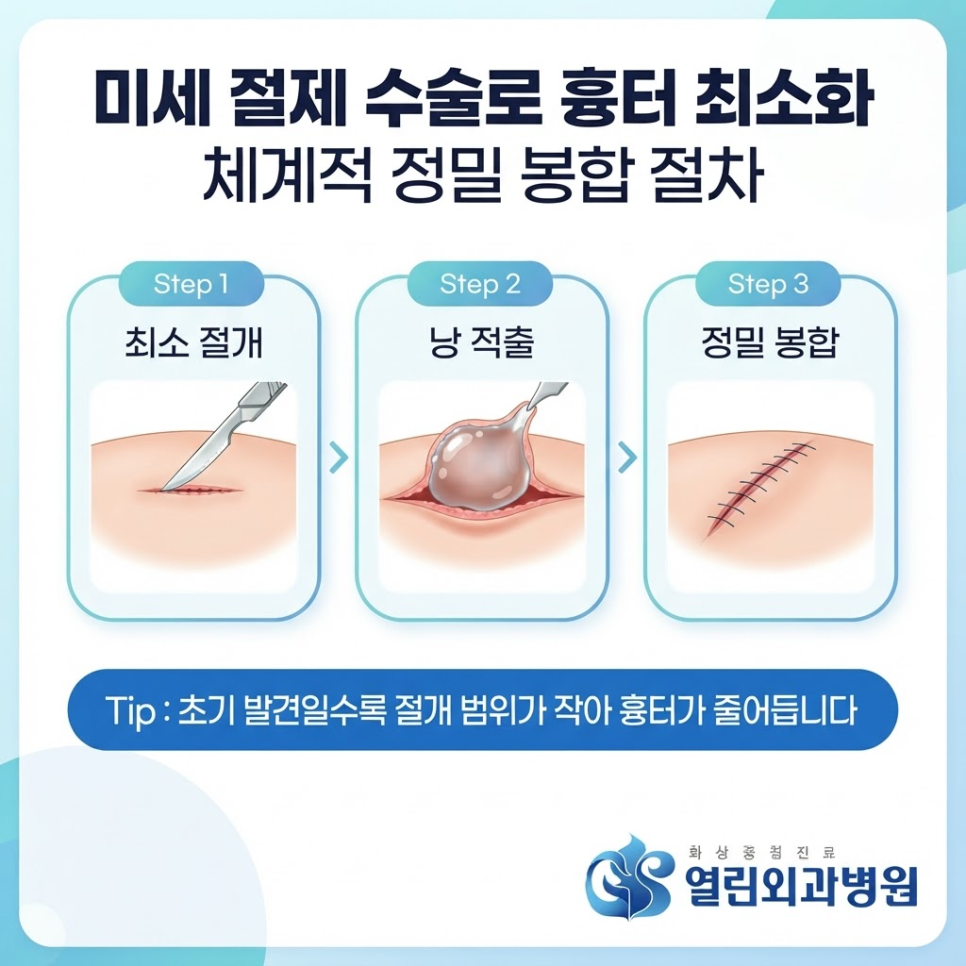
Advances in medical technique now allow the entire cyst wall to be drawn out and removed through a minimal incision — a method known as minimal excision.
Seeking treatment early tends to be more favorable for scar management.
Treating a cyst before it grows larger can help keep the incision and suture marks smaller.

A systematic, minimal excision approach can help limit the extent of tissue damage.
Fine suture material can help make the resulting scar less noticeable.
Available medical sources generally note that choosing a precise excision technique that removes the cyst completely is important for helping reduce the risk of recurrence.
If you’re looking for a clinic in the Ansan area that offers systematic diagnosis and post-surgical care, you can find more information at Burn Care, [Ansan Yeorin Surgical Clinic] Home.
Why Is Popping a Cyst by Hand Risky?
Squeezing a cyst at home with unsanitary hands or tools carries real risk.
Bacteria under the fingernails can enter through the pore and lead to a secondary infection.
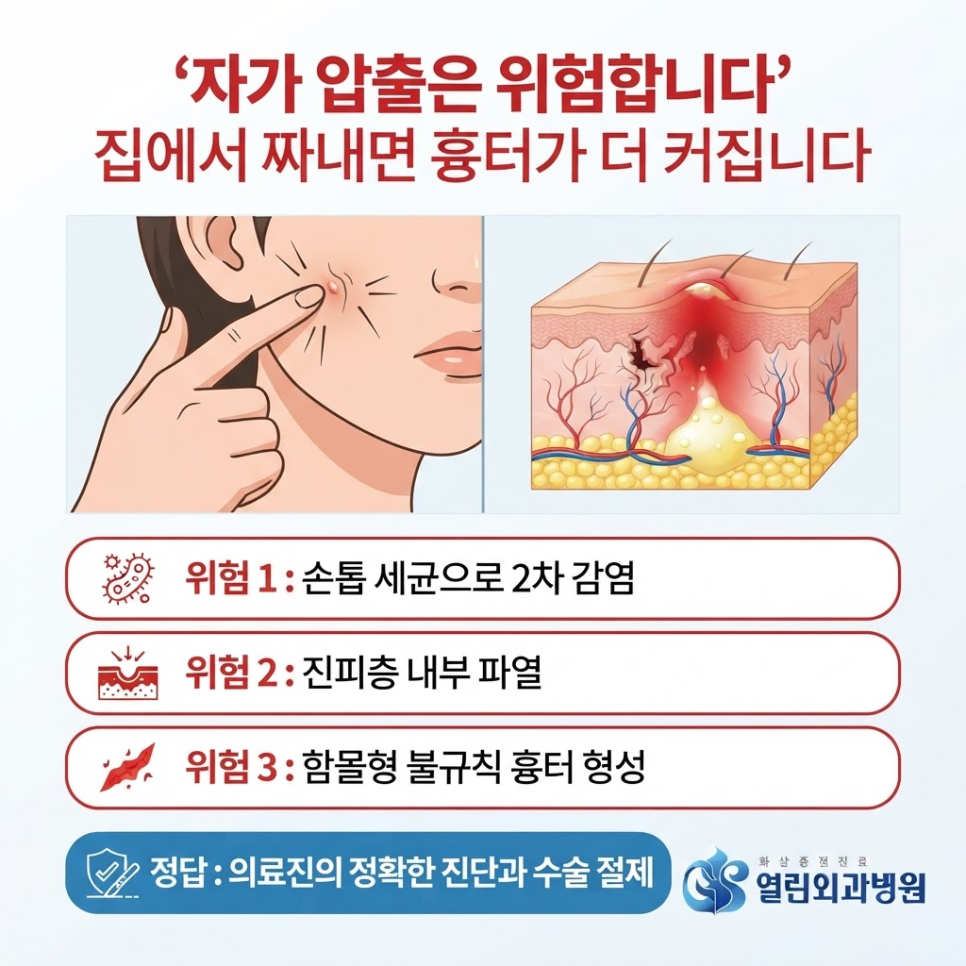
If the sac ruptures beneath the skin, it can leave an ulcer or a depressed scar.
In some cases, this can result in a larger, more irregular mark than surgical treatment would.
Self-extraction can damage the dermis and lead to excessive pigmentation.
Getting medical excision before the cyst becomes inflamed is the safer route.
Rather than forcing extraction based on your own judgment, it’s advisable to get an accurate diagnosis from a medical professional and address the underlying cause.
After surgery, thorough disinfection and consistent use of a healing ointment are recommended.
Using sun protection alongside this can also help reduce the chance of pigmentation at the surgical site.
Frequently Asked Questions
1. Can a sebaceous cyst go away completely with medication or injections alone?
Antibiotics or anti-inflammatory injections can temporarily ease inflammation and pain, but they don’t remove the cyst sac itself from the dermis.
Because of this, recurrence is common, and surgical removal is generally needed to address the underlying cause.
2. I’m concerned surgery might leave a large scar.
Depending on the size and location of the cyst, a minimal excision technique may be an option.
Because the sac is removed through an incision smaller than the cyst itself, followed by precise suturing, the resulting scar can often be kept relatively small.
3. Can I shower or go about daily life right after sebaceous cyst surgery?
Since the procedure is done under local anesthesia, many patients are able to return to daily activities the same day.
That said, a waterproof bandage is needed to keep the suture site dry, and follow-up disinfection may be required for several days.
4. If a cyst has ruptured and is very painful, can it be operated on right away?
If inflammation is severe and the cyst has already ruptured, draining the area and calming the inflammation first — before removing the cyst wall — tends to be the approach that helps minimize tissue damage and scarring.


References
· Asan Medical Center, \”Epidermal Cyst,\” Disease Encyclopedia, Asan Medical Center. Read more
· Seoul Times News, \”[Medical Column] Laser Minimal Excision Reduces Recurrence Compared to Cyst Extraction,\” Seoul Times News, 2025. Read more
This article is intended for general health information purposes only and is not a substitute for individual diagnosis or treatment.
If you’re experiencing symptoms, please consult a medical professional.