Tag: Everyday First Aid

  • Burn First Aid: 3 Steps to Follow in the First 20 Minutes

    Burn First Aid: 3 Steps to Follow in the First 20 Minutes

    SummaryThe key to burn first aid is cooling the area under running water for 15 to 20 minutes immediately after the injury. This guide covers the correct response steps, home remedies to avoid, symptoms by burn stage, and when to see a doctor.

    Have you ever spilled hot soup and instinctively reached for ice?

    Actually, that reflex is a risky mistake that can deepen skin tissue damage.

    How you respond in the first few minutes after a burn can make a major difference in how deep the resulting scar becomes.

    burn first aid

    Key Takeaway
    The core of burn first aid is cooling the affected area under lukewarm running water for 15 to 20 minutes right after the injury.
    Applying ice directly or using home remedies like soybean paste or toothpaste raises the risk of infection and further damage.
    This article walks through the full process of burn first aid—the correct response steps, symptoms by burn stage, and situations that call for a hospital visit.

    Key Points
    ✔ Cool the burn under running water for 15–20 minutes right away
    ✔ Ice and home remedies can make the damage worse
    ✔ Whether you need to see a doctor depends on blister size, location, and extent

    What’s the First Thing to Do When You Get a Burn?

    The first thing you should do is cool the burn under running water.
    Burn first aid refers to the process of stopping contact with the heat source and lowering skin temperature to prevent further damage.

    The National Health Information Portal also recommends cooling the burn under cool running water and not popping any blisters.

    “Cool the burned area under cool running water for at least 20 minutes, and do not pop any blisters.”

    This guidance comes from the Korea Disease Control and Prevention Agency via the National Health Information Portal.

    burn first aid illustration 2

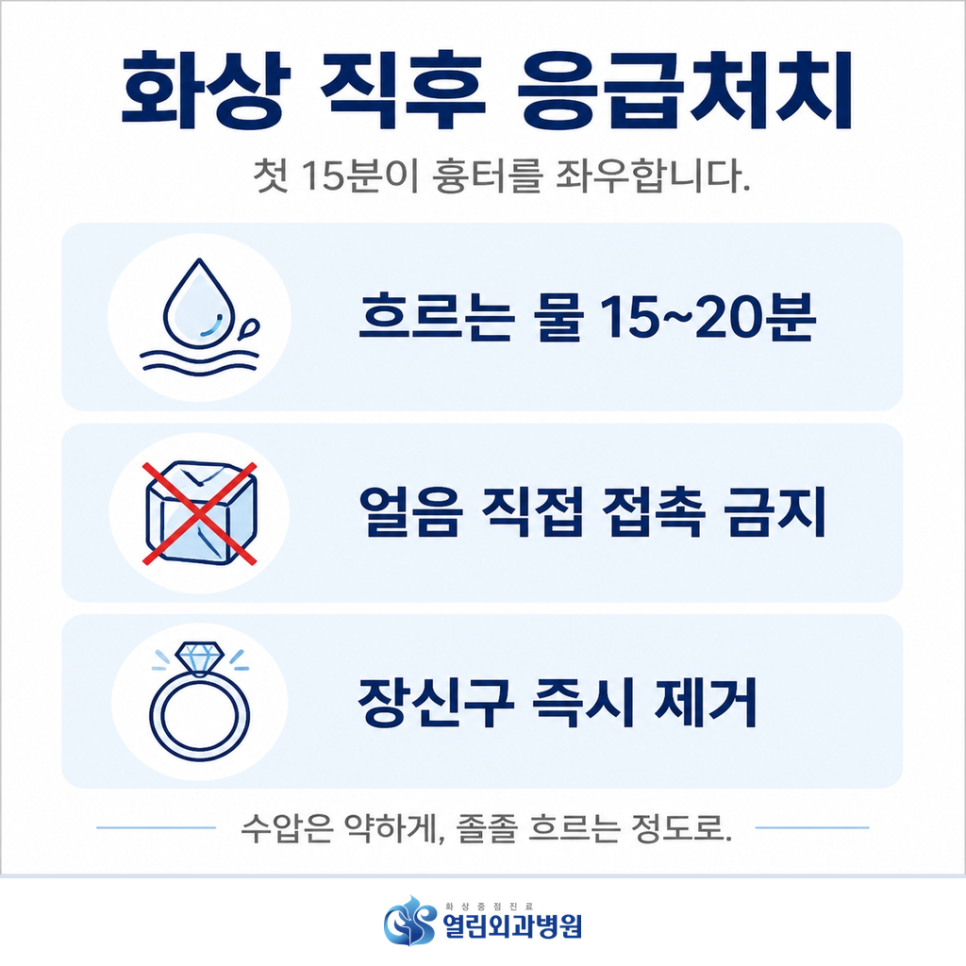
    Lukewarm tap water, around 15–20°C (59–68°F), is generally recommended for cooling the burn.

    Water pressure matters too.
    Water that’s too forceful can further irritate the wound surface.

    So it’s safest to use a gentle, low-pressure stream of water for 15 to 20 minutes.

    Remove any jewelry right away, before swelling sets in.
    Once swelling occurs, it can restrict blood flow and cause bigger problems.

    Avoid forcibly removing clothing.
    Fabric stuck to the skin can worsen the injury if pulled off.
    It’s safer to cool the area with clothing still on, then cut the fabric away with scissors.
    burn first aid illustration 3

    Checklist
    ✅ Cool the burn under running water for 15–20 minutes
    ✅ Don’t apply ice directly (risk of vessel constriction)
    ✅ Remove jewelry immediately, before swelling starts
    ✅ Don’t pull off clothing—cool with water first, then cut it away with scissors

    burn first aid illustration 4


    Is It Safe to Put Toothpaste or Soybean Paste on a Burn?

    The short answer: it’s not recommended.
    A home remedy is a self-treatment method that hasn’t been medically verified.

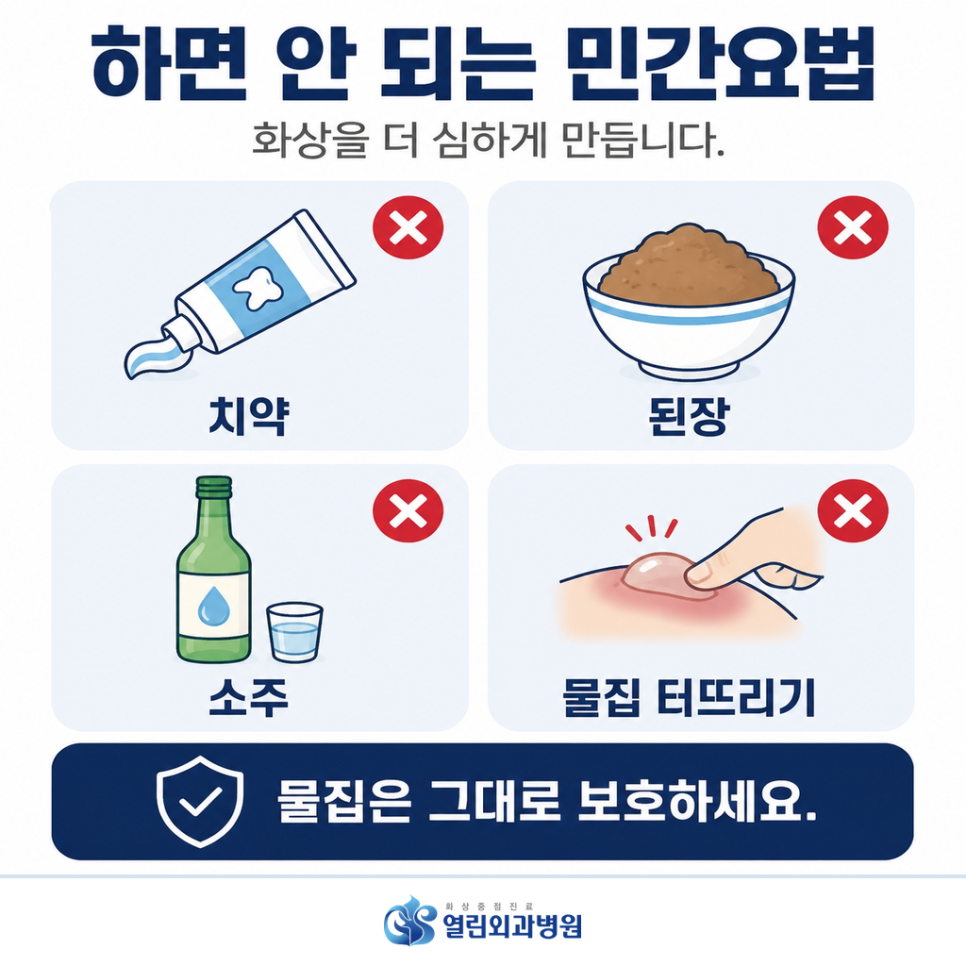
    In a panic, some people reach for toothpaste, soybean paste, or even sliced potatoes.

    But these substances can trap heat in the wound and raise the risk of bacterial infection.
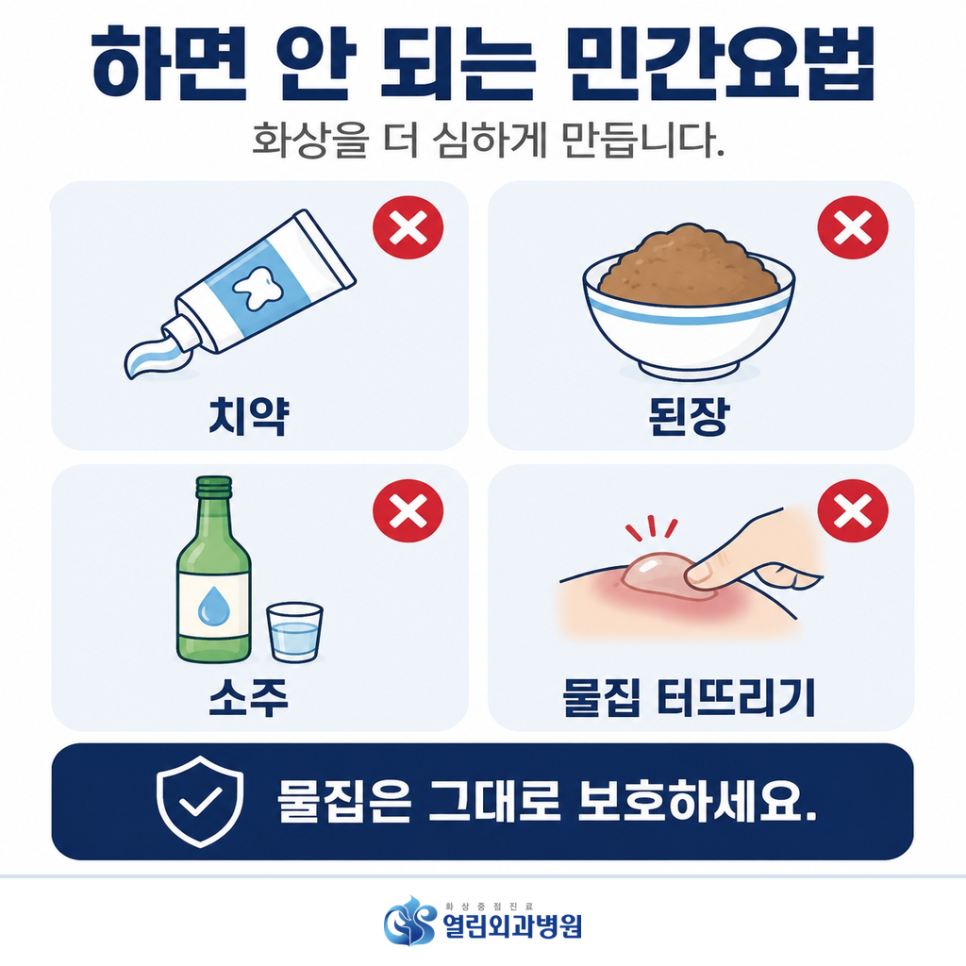
    Pouring soju on a burn—hoping the alcohol’s evaporation will cool it—only irritates the already-damaged skin barrier further and makes the wound worse.
    burn first aid illustration 5

    Precautions
    🚫 Don’t apply toothpaste, soybean paste, cucumber, or other foods
    🚫 Don’t pour soju or alcohol directly on the wound
    🚫 Don’t pop blisters yourself
    🚫 Don’t self-apply unverified topical remedies

    Popping a blister with your fingers is just as risky.

    Blister fluid acts as a natural barrier that protects the wound from outside bacteria.
    Breaking it open can lead to secondary infection, slower healing, and more severe scarring.
    Leave blisters intact and keep them clean and protected.

    burn first aid illustration 6


    What Are the Degrees of Burns, and How Do Symptoms Differ?

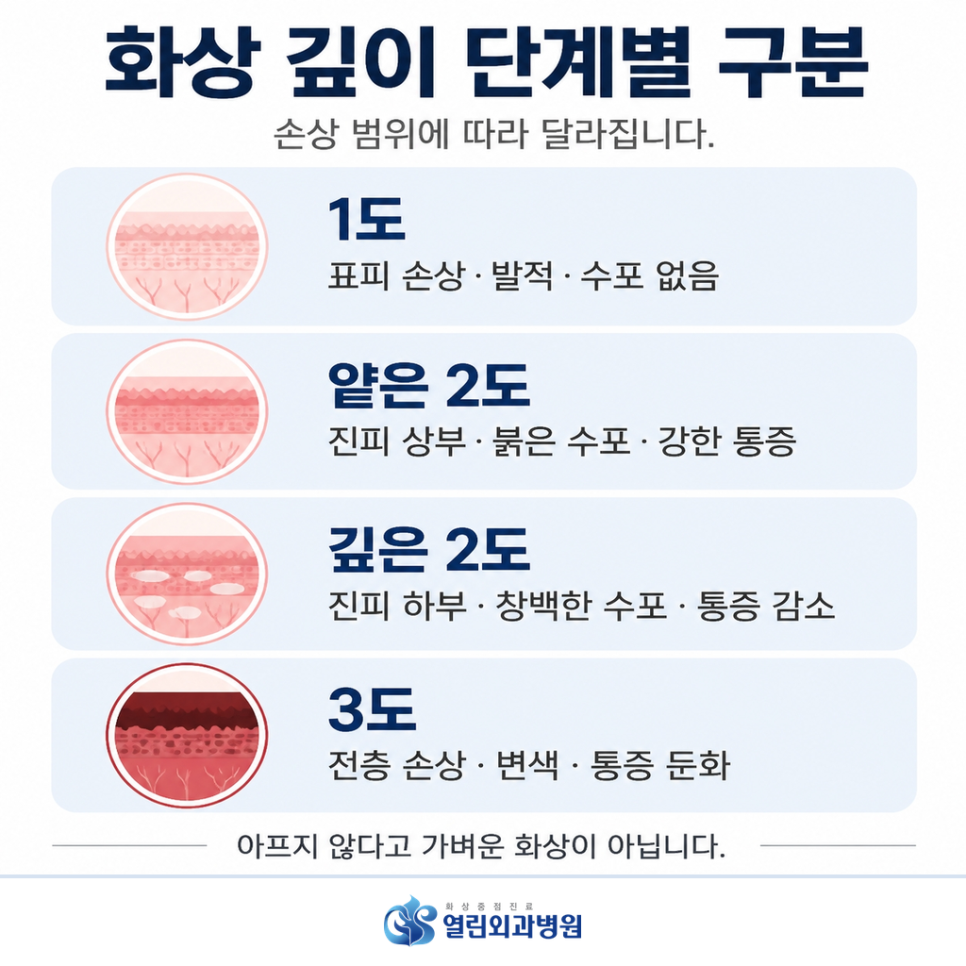
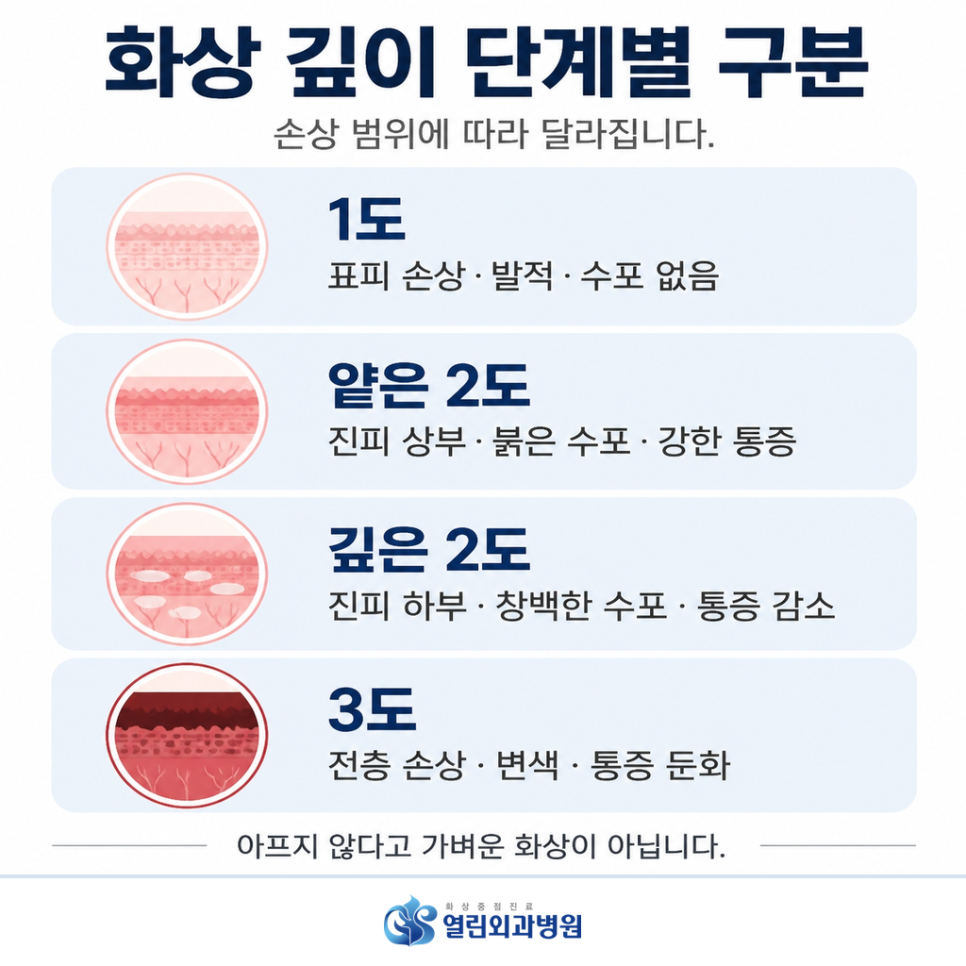
    Burns are classified from first to third degree based on how deep the damage goes.
    The deeper the burn, the longer the healing time and the greater the risk of scarring.

    Degree Depth of Damage Main Symptoms Pain
    1st Degree Epidermis Redness, no blisters Mild pain
    Superficial 2nd Degree Upper dermis Red blisters Severe pain
    Deep 2nd Degree Lower dermis Pale blisters Reduced pain
    3rd Degree Full-thickness skin Discoloration, eschar formation No pain (nerve damage)

    burn first aid illustration 7

    Second-degree burns damage the dermis and come with blisters and significant pain.
    Healing typically takes about 2 to 4 weeks, and scarring or skin discoloration can remain afterward.

    When damage reaches deep into the dermis, nerve endings can be destroyed, which paradoxically means less pain is felt.

    But less pain doesn’t mean the injury is less serious.
    Third-degree burns destroy the full thickness of the skin, causing discoloration, and generally do not heal on their own—professional treatment is recommended.
    burn first aid illustration 8


    When Should You See a Doctor After Burn First Aid?

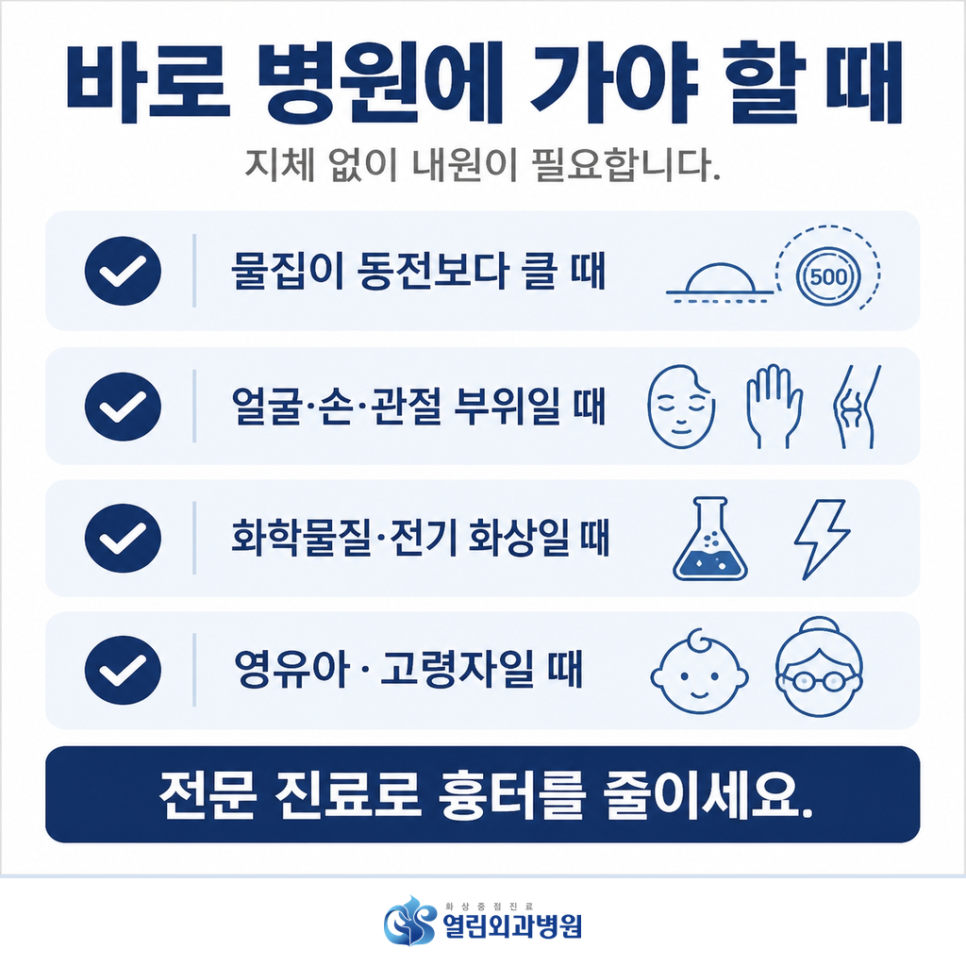
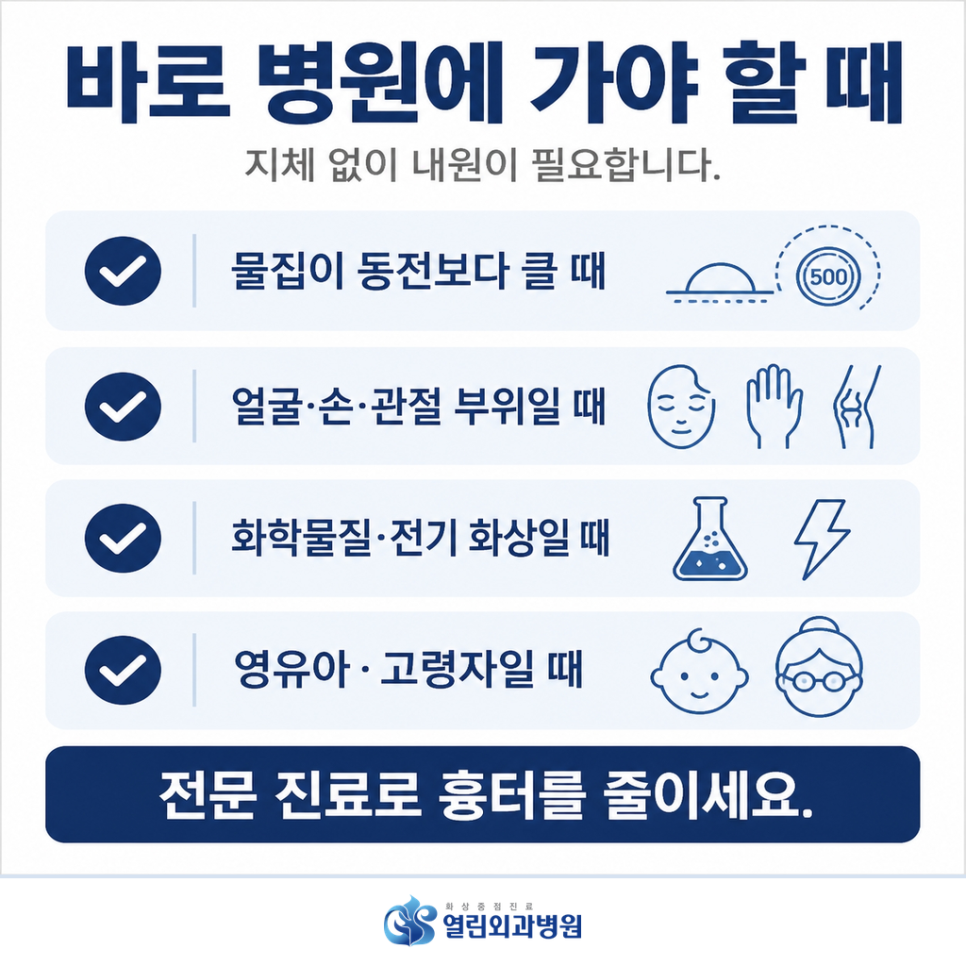
    If the burn is on the face, hands, feet, or a major joint, head to the hospital without delay.
    Burns over joints can cause the skin to tighten as it heals, which may limit range of motion.
    burn first aid illustration 9

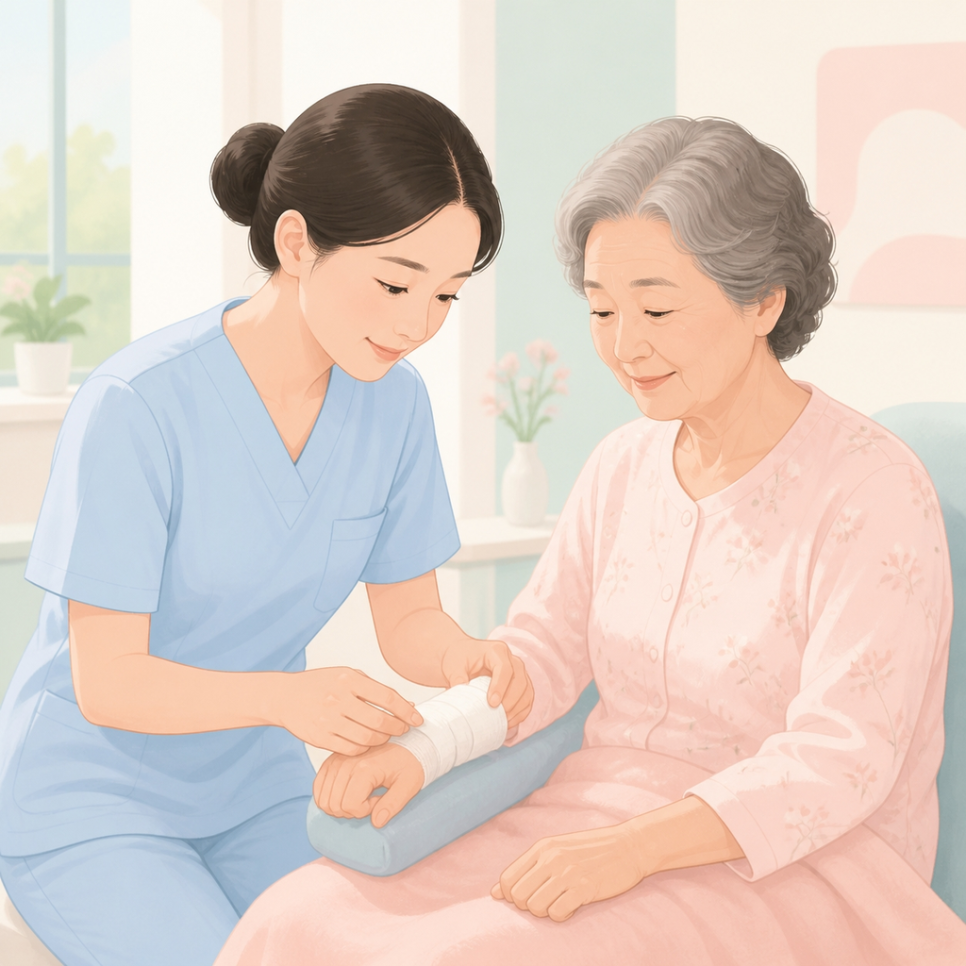
    Burns covering a large area, or those affecting infants or older adults, also call for prompt medical attention.
    People with weaker immunity can experience whole-body effects even from a relatively small burn.

    When You Should See a Doctor Right Away
    🎯 The blister is larger than a coin
    🎯 The burn is on the face, hands, or a joint
    🎯 The injury was caused by chemicals or electricity
    🎯 The injury occurred in an older adult or a young child

    burn first aid illustration 10

    After first aid, it’s best to have your condition properly assessed at a medical facility for hygienic dressing and infection prevention.

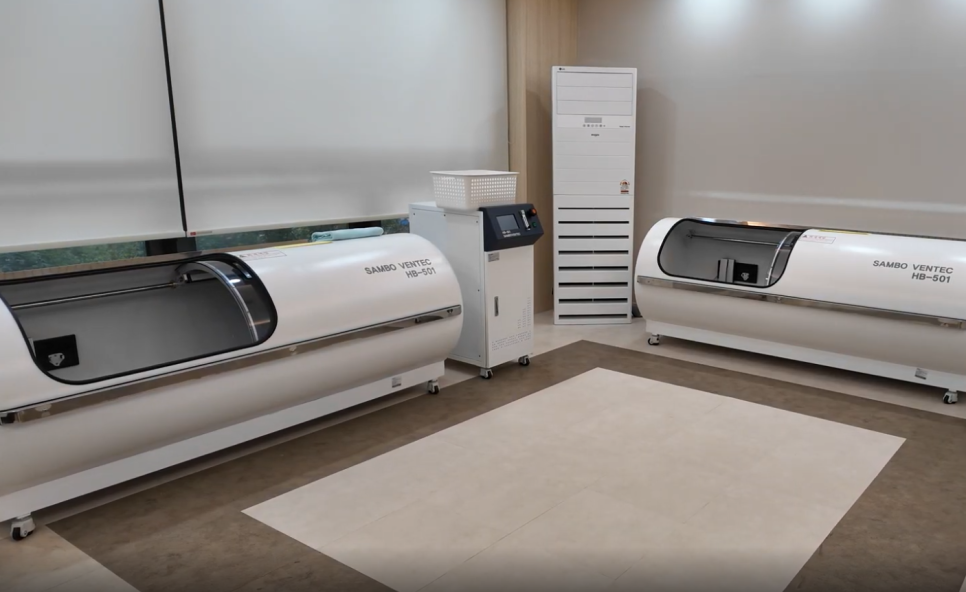
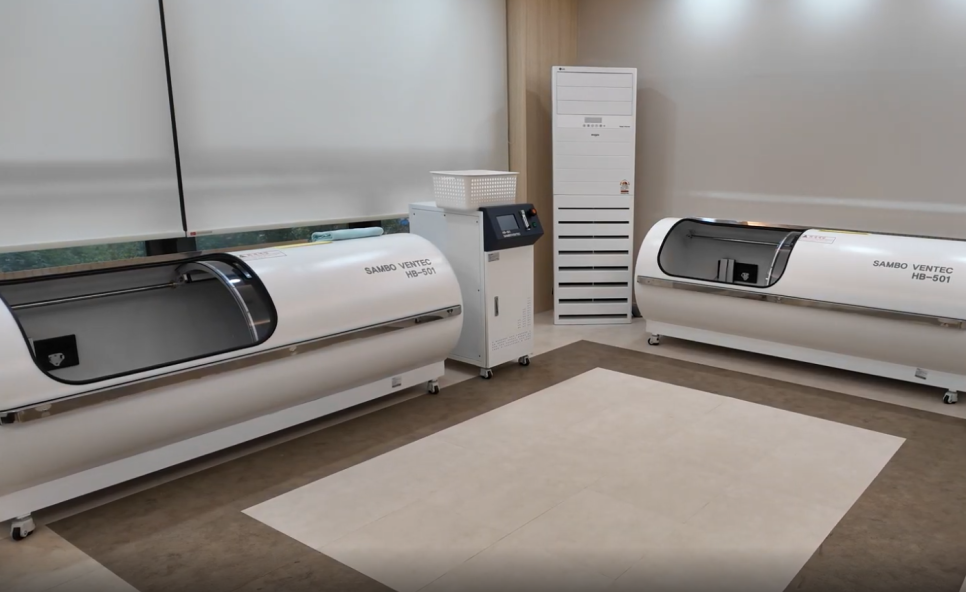
    Our hospital operates a burn treatment system intended to make care available outside regular daytime hours.
    You can find more detailed treatment information at Burn Treatment — Ansan Open Surgery Hospital Home.


    Frequently Asked Questions

    1. When is the right time to apply ointment to a burn?
    Answer: Applying ointment while the burn still feels hot can trap heat in and worsen the damage. It’s best to cool the area thoroughly with cold water, pat it dry, and then apply an infection-prevention ointment.

    2. How should you care for a blister that has already popped?
    Answer: Don’t peel off the blister skin—leave it in place and gently clean the area with sterile saline. Then protect it with an appropriate dressing to reduce the risk of bacterial infection and visit a hospital.

    3. Why shouldn’t you put ice directly on a burn?
    Answer: Direct contact with ice causes skin blood vessels to constrict rapidly, restricting circulation and potentially causing secondary damage similar to frostbite. Running water at 15–20°C (59–68°F) is generally used to cool a burn instead.

    burn first aid illustration 11


    References

    · Korea Disease Control and Prevention Agency, “Burns,” National Health Information Portal, 2024. View source
    · National Emergency Medical Center, “Heat/Cold-Related Injuries – Burns,” National Emergency Medical Information Center (E-Gen), 2023. View source
    · Nate News, “‘Ouch, That’s Hot!’ Skip the Soju and Soybean Paste While Frying Pancakes — Burn First Aid Tips,” Nate News, 2026. View source
    burn first aid illustration 12

    This article is intended for general health information purposes and is not a substitute for individual diagnosis or treatment. If you have symptoms, please consult a medical professional.
  • Burn First Aid: 4 Steps to Take in the First 20 Minutes

    Burn First Aid: 4 Steps to Take in the First 20 Minutes

    SummaryThe key to burn first aid is cooling the area under running cool water for 15 to 20 minutes. Many people confuse this with icing a burn or mishandle blisters. Ansan Burn Hospital breaks down why home remedies like toothpaste or soybean paste can be risky, how burn degrees are classified, and when it’s time to see a doctor.

    The moment you spill hot soup on yourself, is reaching for ice your first instinct?

    This reflex, which many people assume is correct, can actually make skin damage worse.

    How you handle the first few minutes after a burn can affect how deep the resulting scar becomes.

    Key Takeaway
    The key to burn first aid is cooling the area under running cool water for 15 to 20 minutes.
    Applying ice directly, or using home remedies like toothpaste or soybean paste, can make the damage go deeper.
    This article walks through what to do immediately after a burn, what to avoid, how burns are classified by degree, and when to seek medical care.

    Burn first aid

    What’s the First Step in Burn First Aid?

    The first thing to do right after a burn is cool the area under running cool water.
    Burn first aid is the process of stopping contact with the heat source and lowering skin temperature to prevent further damage.

    The moment skin touches a hot pot or spilled soup, the heat trapped inside doesn’t disappear on its own.
    If that heat isn’t drawn out quickly, the damage can spread into deeper layers of skin.

    That’s why cooling the burn is the very first thing to do.

    Burn first aid illustration 2

    1. Run tap water over the affected area for 15 to 20 minutes to cool it down.
    2. Keep the water pressure gentle, like a light trickle, rather than a strong stream.
    3. Remove rings, watches, and other jewelry right away, before swelling sets in.
    4. If clothing is stuck to the skin, don’t force it off—cool the area with water first, then cut the fabric away with scissors.

    “Burned skin should be cooled under running cool water for at least 15 to 20 minutes. Applying ice directly can cause blood vessels to constrict rapidly, which may actually deepen tissue damage.”

    This is how Korea’s Disease Control and Prevention Agency describes burn first aid on its National Health Information Portal.

    Key Point: Proper Cooling Guidelines
    ✅ Run water over the area for 15 to 20 minutes to remove trapped heat.
    ✅ Don’t apply ice directly to the wound (risk of blood vessel constriction).
    ✅ Remove jewelry immediately, before swelling begins.

    Burn first aid illustration 3


    Is It Really Okay to Apply Toothpaste or Soybean Paste?

    Home remedies like toothpaste, soybean paste, or soju can actually make a burn worse.
    A home remedy is a self-treatment method passed down informally, without medical verification.

    In the panic of the moment, it’s tempting to reach for whatever’s in the kitchen.
    But toothpaste, soybean paste, and potato juice trap heat inside the wound.

    These substances can also introduce bacteria and lead to infection.
    Pouring soju or other alcohol on a burn is no better.
    Alcohol further irritates skin whose barrier is already damaged.

    Burn first aid illustration 4

    Burn first aid illustration 5

    Caution: Things You Should Never Do
    🚫 Applying toothpaste, soybean paste, cucumber, or other food items
    🚫 Pouring soju or alcohol directly on the wound
    🚫 Popping a blister with your fingers
    🚫 Self-applying unverified topical products

    There’s a reason you shouldn’t pop a blister.
    Blister fluid acts as a natural barrier that protects the wound from bacteria.

    Forcing a blister open is thought to increase the risk of deeper scarring.
    Leave blisters intact and keep the area clean instead.

    Burn first aid illustration 6


    How Are Burn Degrees Classified?

    Burns are classified from first-degree to third-degree based on how deep the damage goes.
    Burn degree is a classification based on how much of the epidermis and dermis has been damaged.

    First-degree burns affect only the epidermis, causing redness and a stinging sensation.
    From second-degree burns onward, blisters form and pain intensifies.

    However, when damage reaches deep into the dermis, nerve endings can be destroyed, which may actually reduce pain.
    Less pain doesn’t mean less damage, so the area should be examined carefully.

    Burn first aid illustration 7

    Degree Depth of Damage Main Symptoms
    First-degree Epidermis Redness, pain, no blisters
    Superficial second-degree Upper dermis Red blisters, intense pain
    Deep second-degree Lower dermis Pale blisters, reduced pain
    Third-degree Full skin thickness Discoloration, painless due to nerve damage

    Burn first aid illustration 8


    When Should You Go to the Hospital Right Away?

    Burns on the face, hands, or joints, or burns covering a large area, call for prompt medical attention.
    A burn that needs immediate care is one where natural healing is unlikely or there’s a meaningful risk of losing function.

    According to a report by The Seoul Shinmun, about 67% of burn accidents in Korea happen at home.
    The same report found that infants and toddlers aged 0 to 4 made up 29% of all burn patients in Korea.

    Infants and older adults, who tend to have weaker immune systems, can experience wider-reaching effects from even a small burn.
    Burns near joints can cause the skin to contract as it heals, which may limit range of motion.

    Checklist: When to Seek Care Right Away
    ✅ The blister is larger than a coin
    ✅ The burn is on the face, hands, or a joint
    ✅ The burn was caused by a chemical or electrical source
    ✅ The burn occurred in an older adult or a young child

    Burn first aid illustration 9

    Burn first aid illustration 10

    Finishing first aid isn’t the end of the process.
    A proper evaluation and dressing from a medical professional can help minimize scarring.

    We recommend having your burn assessed at the Burn Treatment page of Ansan Open Surgery Hospital, which has experience treating burns.

    Burn first aid illustration 11

    Burn first aid illustration 12


    Frequently Asked Questions

    1. When should you apply ointment to a burn?
    Applying ointment while the burn still feels hot can trap heat inside and worsen the damage. It’s best to cool the area thoroughly with cool water, pat it dry, and then apply an infection-prevention ointment.

    2. How should you care for a blister that has already popped?
    Don’t peel away the loose skin—leave it in place and gently clean the area with sterile saline. After that, protect it with an appropriate dressing and see a doctor to be safe.

    3. Why shouldn’t you put ice directly on a burn?
    Direct contact with ice causes skin blood vessels to constrict sharply, which restricts circulation and can cause secondary damage similar to frostbite. Always cool a burn with running cool water instead.


    References

    · Korea Disease Control and Prevention Agency, “Burns,” National Health Information Portal, KDCA. View source
    · Ministry of the Interior and Safety, “First Aid – Burns,” Korea Safety (안전24), MOIS. View source
    · The Seoul Shinmun, “29% of Burn Patients Are Ages 0–4… 67% Occur at Home,” The Seoul Shinmun, 2018. View source
    · Hidoc, “‘Don’t Pop the Blister’… A Surgeon Explains How to Handle Burns,” Hidoc, 2025. View source


    This article is intended for general health information purposes only and is not a substitute for individual diagnosis or treatment. If you have symptoms, please consult a medical professional.