Tag: Skin Regeneration

  • Flat Iron Burn Scar: 15-Minute Golden Window First Aid & Prevention Guide

    Flat Iron Burn Scar: 15-Minute Golden Window First Aid & Prevention Guide

    SummaryFor a flat iron burn scar, the golden window is cooling the area under running cold water for 15 to 20 minutes right after contact. This guide covers the first aid steps, how to care for blisters, skin recovery habits that help reduce discoloration, and ways to prevent flat iron burns in the first place.

    You’re rushing to get ready in the morning, styling your bangs, when the hot plate of your flat iron brushes against the back of your neck.
    The sting only lasts a moment, but a few hours later the spot turns red, swells, and even blisters.

    It was just a light touch, so why does the mark linger so long?
    A flat iron burn scar starts with a split second of carelessness, but how deep the mark ends up depends heavily on what you do right after it happens.

    flat iron burn scar

    Key Takeaways
    To help reduce a flat iron burn scar, an important first step is cooling the area under running cold water for 15 to 20 minutes right after contact.
    Leave blisters intact and cover them with a clean dressing; once the skin has re-epithelialized, staying consistent with sun protection and moisturizing can help reduce discoloration and scarring.
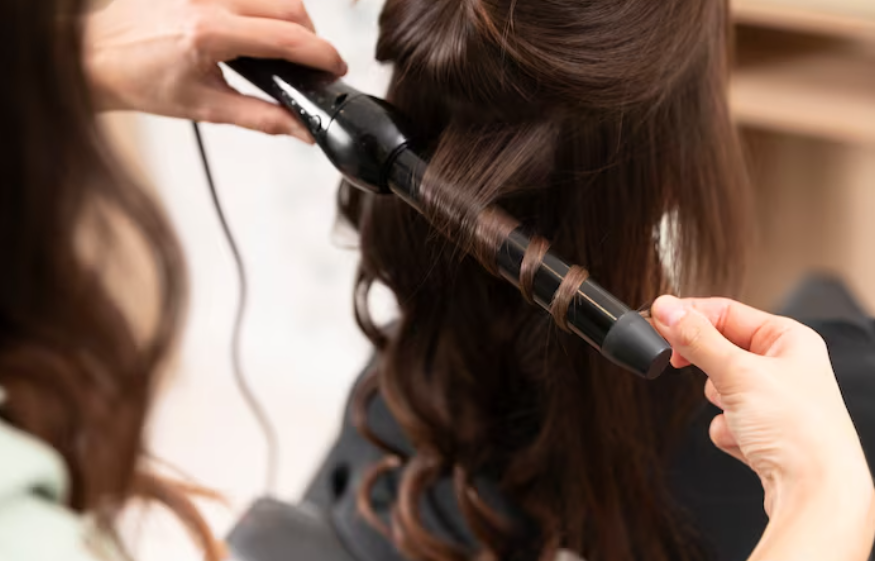
    Flat iron plates can reach up to 215°C (419°F), so accidental contact is a risk not only while it’s in use but also right after you turn it off.

    Why Can a Flat Iron Burn Turn Into a Second-Degree Burn So Fast?

    A flat iron is a high-heat tool that can damage skin all the way down to the dermis with just a brief touch.
    A flat iron burn is thermal skin damage caused by momentary contact with plates or heating elements that reach roughly 150–200°C (300–390°F).

    When the Korea Consumer Agency measured the plate temperature of flat irons on the market, it found that the peak temperature during use reached 215°C (419°F).
    Even after the device was switched off, the plates stayed above 100°C (212°F) for about 5 minutes.

    That’s why an unguarded brush against the back of the hand or neck right after use can easily cause a burn.
    Thin-skinned areas like the face, neck, and back of the hand are especially prone to oozing or blistering because heat transfers to them faster.

    Flat iron burn scar illustration 2

    Flat iron burn scar illustration 3

    According to the Korea Consumer Agency, 200 of 268 burn injuries among children under age 10 — 74.6% — occurred on the hands and arms.
    Younger children, who are less able to sense and avoid danger, were more likely to be injured by directly touching or grabbing a hot flat iron.

    The plate’s peak temperature rose to 215°C, and it remained above 100°C for about 5 minutes even after the power was switched off.

    Based on these findings, the Korea Consumer Agency advised households with children not to put a flat iron away immediately after use, but to leave it somewhere out of reach until it has fully cooled down.

    Key Points
    ✅ The thinner the skin, the faster heat transfers and the deeper the damage tends to be.
    ✅ The first priority is identifying early on whether it’s a first-degree burn (epidermis only) or a second-degree burn (with blistering).

    What’s the Golden-Window First Aid for Reducing a Flat Iron Burn Scar?

    Cooling the burn for 15 to 20 minutes immediately after it happens can play a major role in how deep the resulting scar may be.
    Golden-window first aid means using running cold water right after a burn to remove residual heat and help keep the damage from spreading deeper into the dermis.

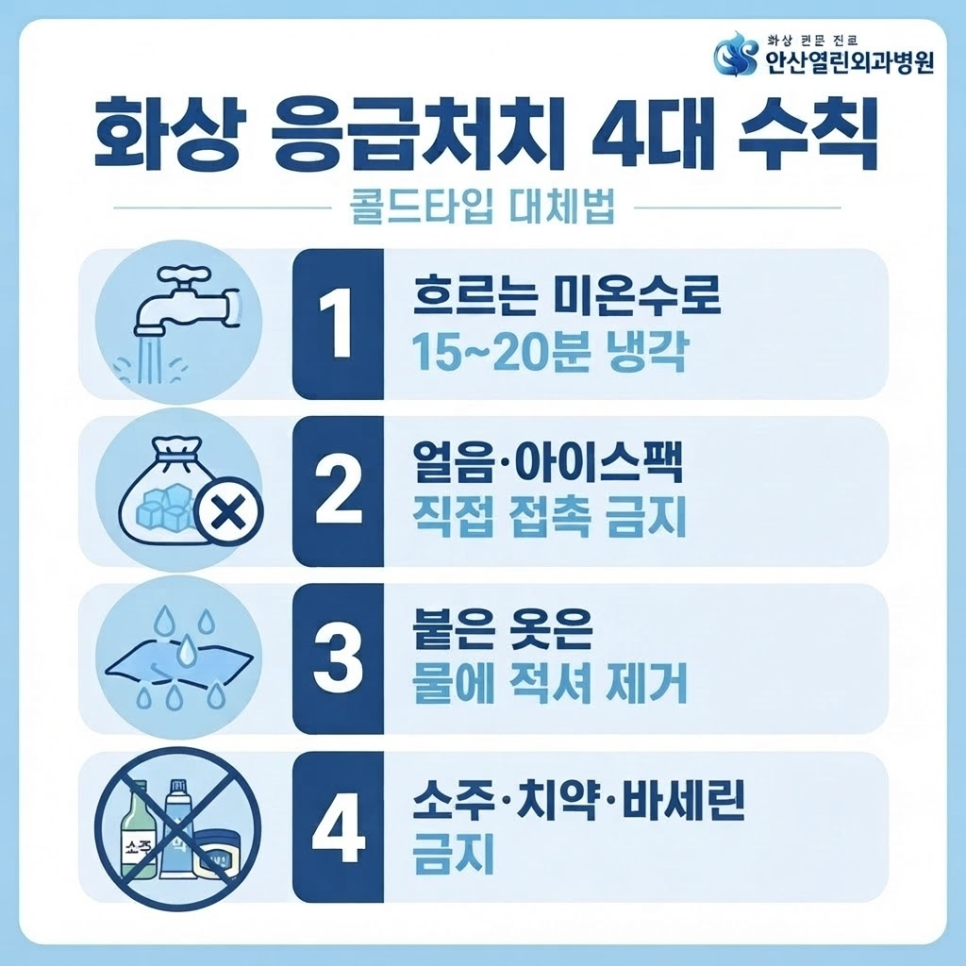
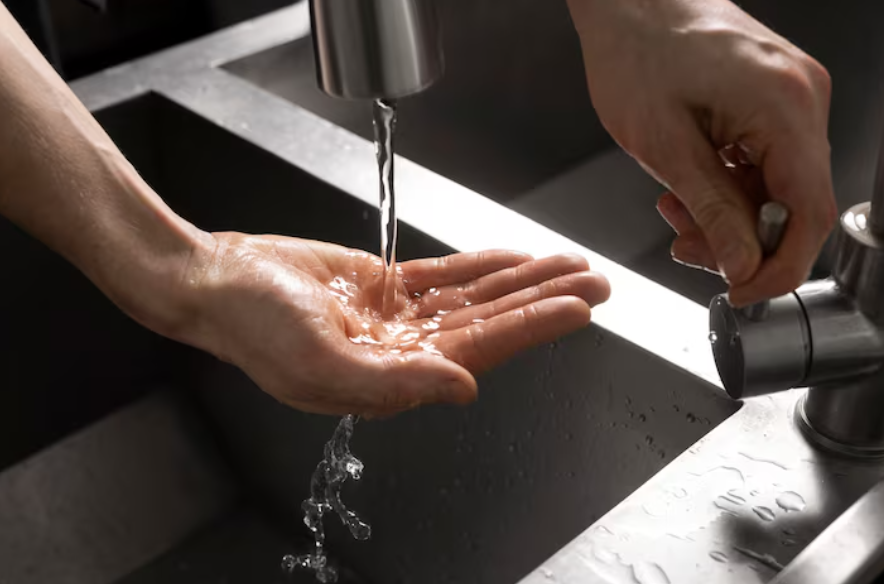
    Cool the burned area thoroughly under running cold water for at least 15 to 20 minutes, and do not pop any blisters.

    That’s how the Korea Disease Control and Prevention Agency (KDCA) describes it in the burn guidance on its National Health Information Portal.
    That said, if the burn covers a large area, it’s better to let water run evenly over it rather than submerging the whole body, to avoid the risk of hypothermia.
    Flat iron burn scar illustration 4

    Precautions
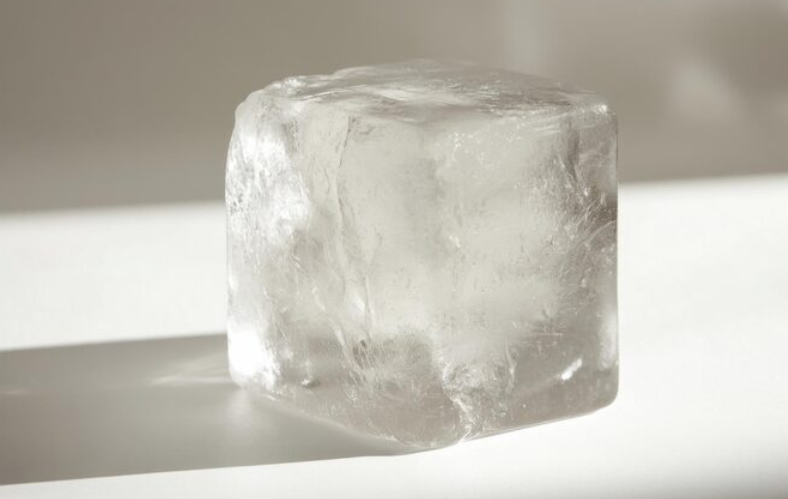
    ⚠️ Applying ice directly to the wound can irritate the tissue and worsen the damage.
    ⚠️ Avoid home remedies like toothpaste or soju entirely — they only increase the risk of infection.
    Flat iron burn scar illustration 5

    Checklist
    ✅ Cool the area under running tap water for 15 to 20 minutes
    ✅ Never apply ice directly or use home remedies
    ✅ Leave blisters intact and protect them with clean gauze
    ✅ Use a gentle, low-irritation foam dressing

    How Do You Manage Burn Marks and Discoloration for Scar-Free Healing?

    Care needs to continue even after re-epithelialization, when new skin has formed over the wound.
    Re-epithelialization refers to the process in which a new epidermis regenerates over damaged skin and the wound closes.

    According to Asan Medical Center, second-degree burns are classified as superficial or deep, depending on how far the damage extends.
    A superficial second-degree burn damages only part of the dermis and typically heals in about 2 weeks, while a deep second-degree burn affects most of the dermis, takes 2 to 4 weeks to heal, and can leave a scar.

    Type Depth of Damage Recovery Time Likelihood of Scarring
    Superficial second-degree burn Partial dermis About 2 weeks Low
    Deep second-degree burn Most of the dermis 2–4 weeks Possible

    If the skin is exposed to UV rays while it’s still red, melanin production can become overactive and leave a dark discoloration.
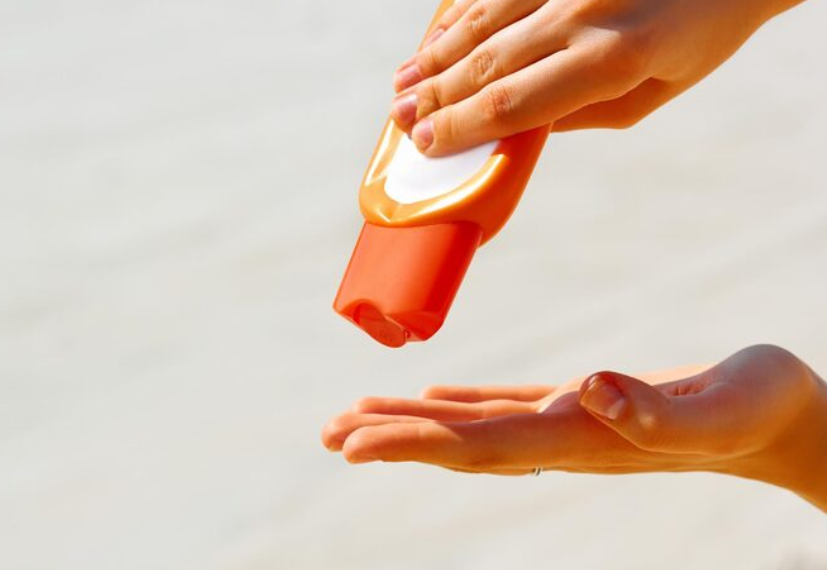
    That’s why it’s important to apply sunscreen thoroughly whenever you go outside and keep moisturizing consistently.
    Flat iron burn scar illustration 6

    Key Points
    ✅ Once the wound has fully closed, consistently using scar ointments or sheet-type care products can help fade marks.
    ✅ Keeping SPF 30+ sunscreen on throughout the healing phase can help lower the risk of discoloration.
    Recovery Care Guide
    · Wound stage: Absorb exudate and block bacteria (use a moist wound dressing)
    · Skin regeneration stage: Sun protection (SPF 30+) and continuous moisturizing
    · Maintenance stage: Use silicone-based products to help stabilize the tissue

    What Habits Help Prevent Flat Iron Burns?

    Preventing an accident in the first place matters far more than treating a burn afterward.
    Practicing the habits below can help lower your risk of ending up with a flat iron burn scar.

    1. Rest the flat iron on a silicone stand or mat while using it or letting it cool
    2. Wear a hair band, and heat-resistant gloves if needed, when styling near your neck or ears
    3. Set the temperature to 150–180°C (300–355°F) instead of an unnecessarily high 200°C+ (390°F+)
    4. Avoid rushed movements and make sure you have a clear view in the mirror before styling
    5. Unplug it right after use and keep it out of reach of children and pets
    Flat iron burn scar illustration 7

    If a mark has already developed or you’re unsure how to manage it, consulting a specialist is also worth considering.
    Burn Treatment Information — [Ansan Yeollin Surgery Clinic] Home has more information you can check out.


    Frequently Asked Questions

    1. What should I do if a blister has already popped?
    A popped blister carries a higher risk of secondary infection. Gently rinse it with tap water or saline, disinfect it, and keep the area clean with a moisture-absorbing wound dressing.

    2. Can a mark that’s already turned red still be managed?
    Redness right after re-epithelialization is a normal part of tissue regeneration. Applying sunscreen and moisturizer consistently during this stage can help reduce the chance of it progressing into discoloration.

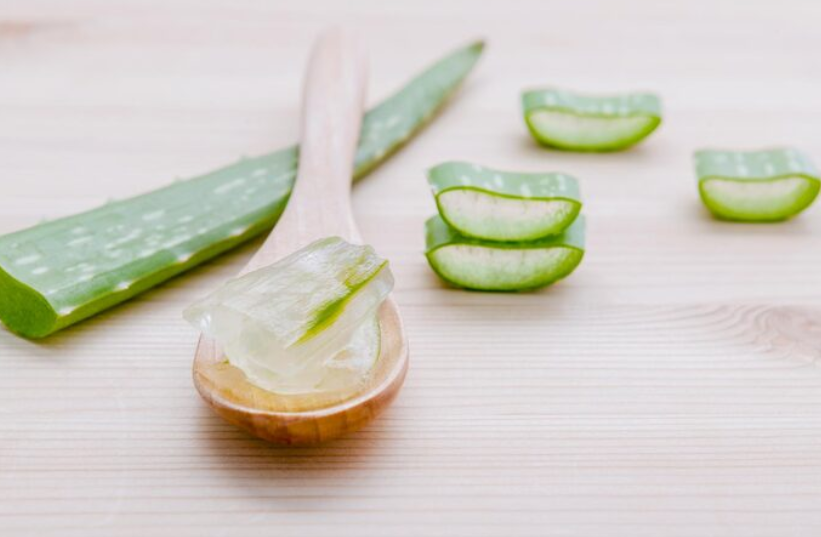
    3. Is it okay to use aloe soothing gel from home?
    It may help cool the area, but if the skin is still oozing or the wound is open, the ingredients can cause irritation or infection. Before the wound closes, it’s safer to use saline or a dedicated wound dressing.
    Flat iron burn scar illustration 8


    References

    · Korea Disease Control and Prevention Agency, “Burns,” National Health Information Portal. View source
    · Korea Consumer Agency, “Watch Out for Flat Iron Burns in Children,” Consumer Safety Information. View source
    · Asan Medical Center, “Burn,” Disease Encyclopedia. View source


    This article is intended to provide general health information and is not a substitute for individual diagnosis or treatment.
    If you’re experiencing symptoms, please consult a medical professional.

  • Appendectomy Scar Care: 3 Steps That May Help Prevent Discoloration

    Appendectomy Scar Care: 3 Steps That May Help Prevent Discoloration

    SummaryAppendectomy scar care depends heavily on how you handle the golden window right after your stitches come out. Here’s why scars can widen, the 3-step care routine by phase, and the daily habits that help prevent discoloration — all in one place.

    Even after your appendectomy stitches have fully healed,
    does the scar on your side still catch your eye every time you look?

    Two people can have the exact same surgery,
    yet one ends up with a scar that’s barely noticeable
    while the other is left with a red, thickened mark.

    That difference isn’t just about skin type —
    how you handle the days right after the stitches come out can matter too.

    When it comes to scar care,
    missing this early golden window often leads to a less-than-ideal result.

    Appendectomy scar care comes down to how you handle the golden window right after stitch removal, while your skin barrier is still rebuilding itself.

    This article walks through why these scars tend to widen, a 3-step care routine by phase, and the daily habits that help prevent discoloration.

    appendectomy scar care

    appendectomy scar care illustration 2

    Why do appendectomy scars often turn out larger than expected?

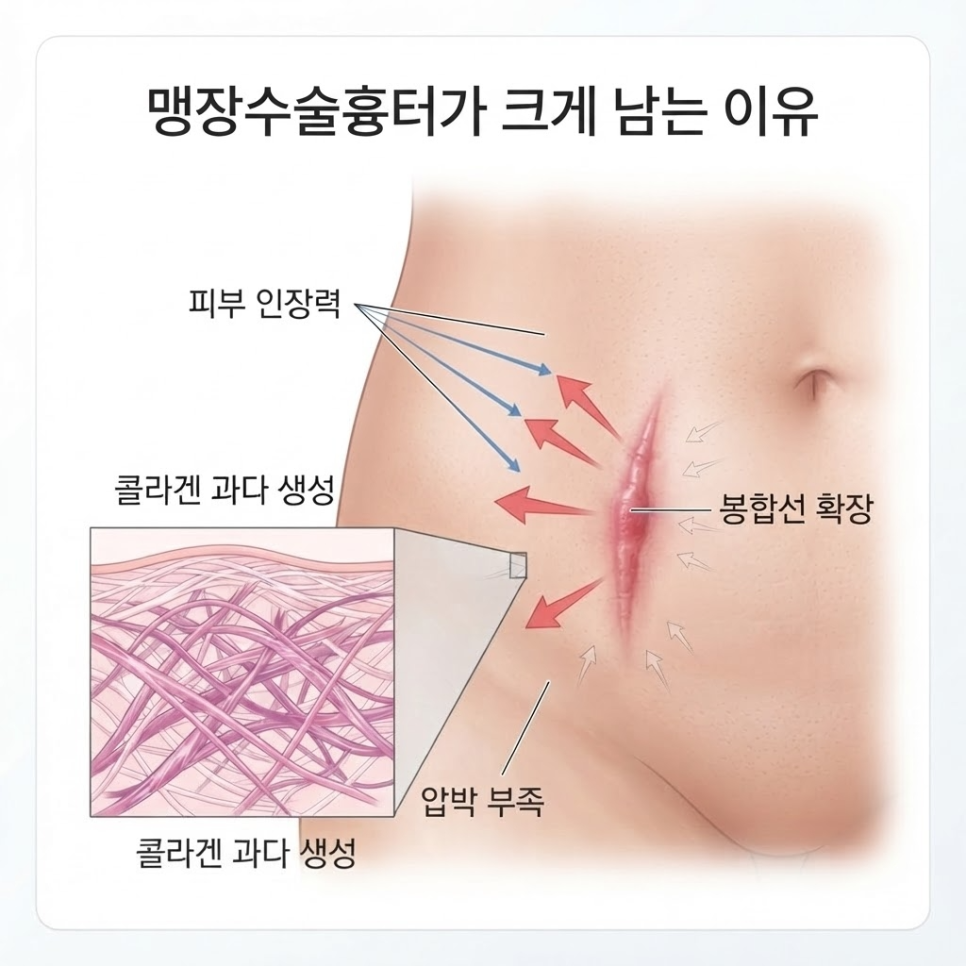
    The abdomen is an area where the skin is constantly being pulled,
    so without proper early care, a scar can end up wider than expected.

    An appendectomy scar is the natural mark left in the dermis as the incision site heals.

    Whether you had laparoscopic or open surgery, if collagen builds up excessively during healing,
    the mark can gradually thicken.

    On top of that,
    the abdomen is a spot where skin tension is especially strong,
    so frequent movement keeps pulling at the wound as it tries to close.

    appendectomy scar care illustration 3

    Without proper protection at this stage,
    the skin on either side of the incision line can stretch, widening the red mark.

    If hydration and physical support aren’t in place early on,
    the risk of the scar raising into a thicker, more visible ridge also increases.

    appendectomy scar care illustration 4

    💡 Key point
    Because the abdomen is under constant skin tension, how you care for it in the first few days after stitch removal is considered an important factor that can affect the eventual width and color of the scar.

    How should appendectomy scar care change over time?

    It can help to split recovery into three phases and adjust your care approach for each one.

    Appendectomy scar care is typically broken into three stages: right after surgery, after stitch removal, and one month and beyond.

    Phase Main Goal Care Method
    Right after surgery Prevent infection, keep the area moist Keep the wound disinfected; keep it fully waterproof
    After stitch removal Ease tension, block irritation Silicone gel products, protective tape
    One month and beyond Prevent hyperpigmentation Apply sunscreen thoroughly

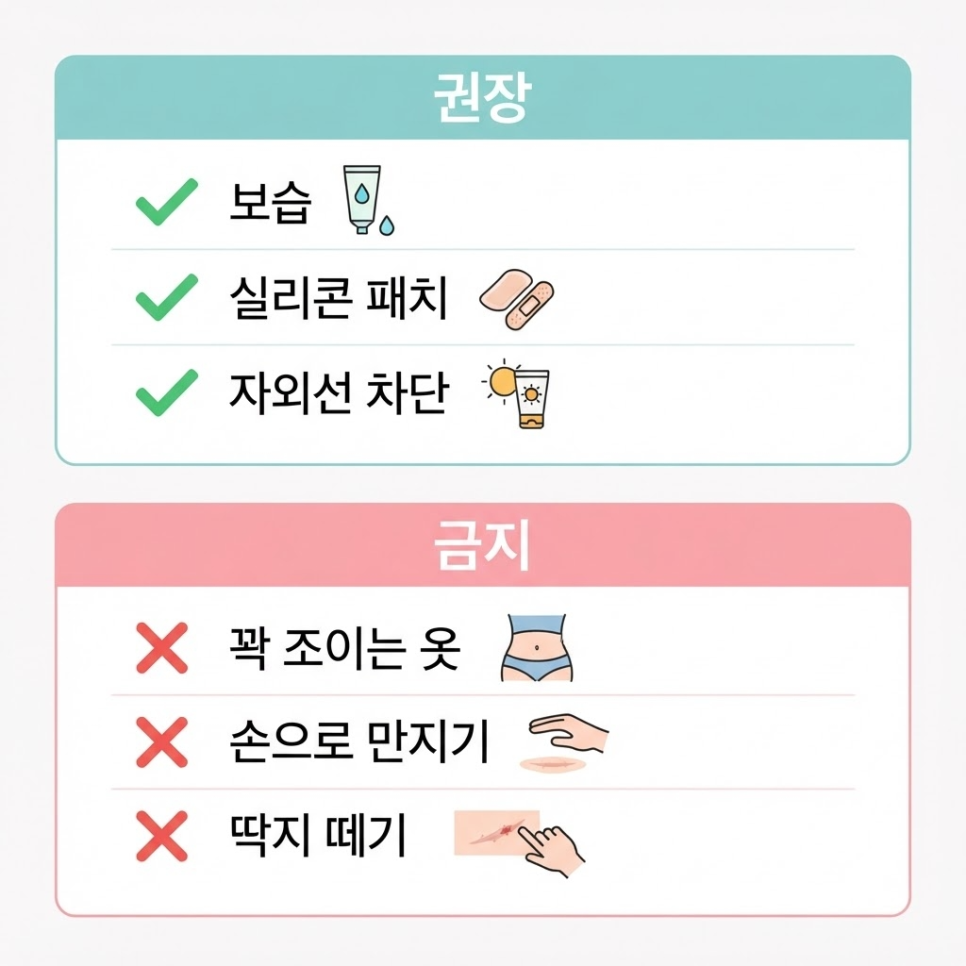
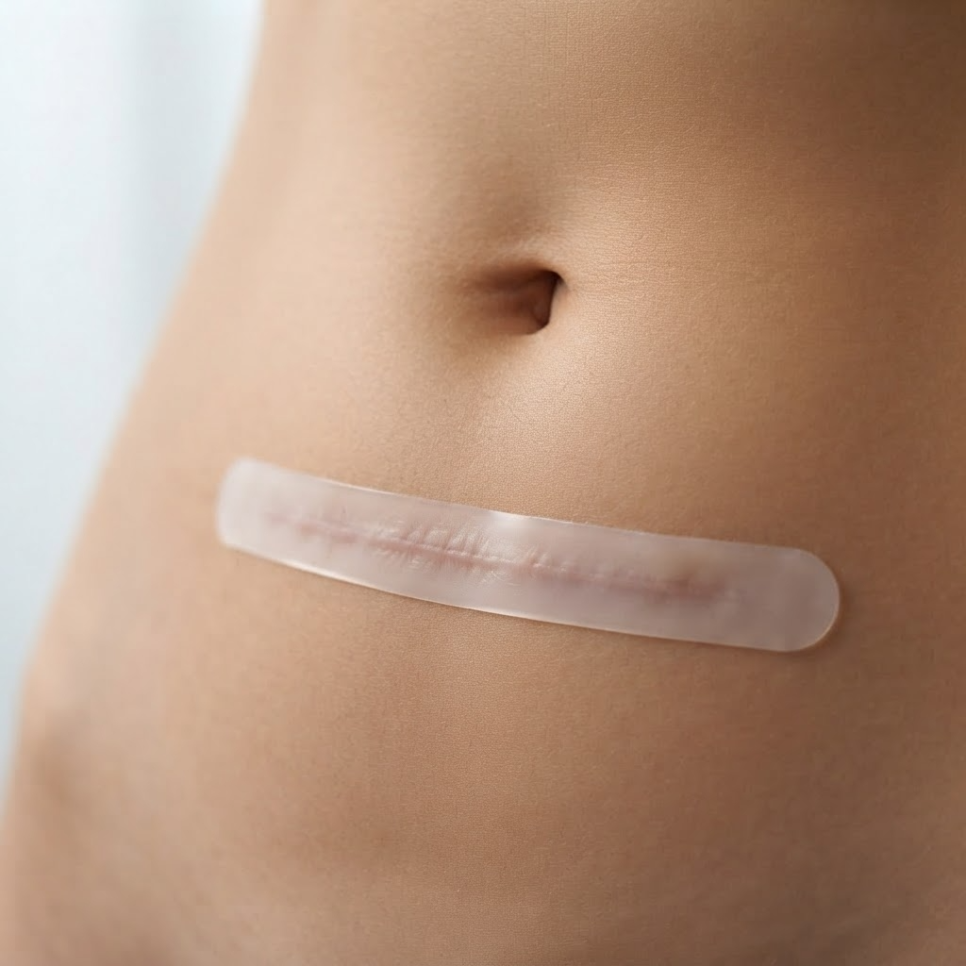
    Starting right after your stitches are removed, it helps to apply silicone-based products or protective tape
    so the area isn’t irritated.

    Irritation that reaches the dermis can lead to hyperpigmentation,
    so keeping the area consistently covered and moisturized is essential.

    appendectomy scar care illustration 5

    📋 Phase-by-phase care checklist
    ✅ Right after surgery: keep the wound disinfected; keep it fully waterproof so water doesn’t touch it directly
    ✅ After stitch removal: ease tension with silicone gel products or patches
    ✅ One month and beyond: prevent hyperpigmentation with sunscreen
    ✅ At every stage: don’t pick at scabs

    What daily habits help prevent scar discoloration?

    Even small changes to your daily habits can go a long way toward keeping a scar from darkening.

    Reducing two triggers — friction and UV exposure — can help prevent discoloration.

    Tight-waisted pants or leggings
    can speed up discoloration through constant friction, so it’s best to avoid them.

    Also,
    UV rays stimulate melanin production,
    which can turn a red mark into a darker, brownish one.

    So,
    when you’re outdoors, even if the scar is covered by clothing,
    it’s a good idea to apply a light layer of sunscreen underneath.

    appendectomy scar care illustration 6

    ⚠️ Caution
    Repeatedly touching the wound or forcibly picking at scabs can raise the risk of secondary infection and progression into a hypertrophic scar.
    💡 Key point
    Cutting down on just these two triggers — friction and UV exposure — may help slow how quickly a scar discolors.

    If, despite consistent care, a scar stays red and hard for a long time,
    self-care alone may not be enough.

    In that case, it’s safer to get an accurate diagnosis
    from a hospital that specializes in scar and burn scar treatment.

    👉 Visit the Ansan Open Surgery Hospital website, a burn treatment specialist, for more information.

    appendectomy scar care illustration 7


    Frequently Asked Questions

    1. When should I start caring for a surgical scar?
    Once the skin has fully closed, right after the stitches come out, using a dedicated silicone product can help support stable healing.

    2. Is it okay that the mark looks red and raised?
    Some temporary redness or puffiness is normal during early tissue repair, but if it keeps swelling, it needs professional evaluation and care.

    3. Can I use soap on it right away when showering?
    Once the scab has come off and the wound is fully closed, gentle rinsing with water is fine, but avoid scrubbing or any harsh friction.

    4. Which is better — ointment or a silicone patch?
    For a high-friction area like the abdomen, a silicone patch is useful because it reduces physical tension; depending on the area, combining it with an ointment can also work.

    5. If the scar becomes hard and lumpy, do I need to see a doctor?
    If it hardens or keeps growing in size, it could be progressing into a hypertrophic scar or keloid, so it’s better to see a specialist rather than rely on self-care alone.


    References

    · Seoul National University Hospital, “How to Manage Scar Treatment,” Hospital News, 2014. Read more
    · Yakup Gongnon (Pharmacist News), “All Pigmented Scars Require Both Treatment and Sun Protection,” Yakup Gongnon, 2016. Read more


    This article is intended for general health information purposes only and is not a substitute for individual diagnosis or treatment. If you have symptoms, please consult a specialist.

  • Burn First Aid: 15-Minute Golden Window Explained

    Burn First Aid: 15-Minute Golden Window Explained

    SummaryBurn first aid centers on cooling the area under running cool water for 15–20 minutes. Together with Ansan Yeollin Surgical Hospital near Gojan Station, let’s look at burn stages and how the clinic manages wound care.

    Even a brief brush against hot soup or a hot iron can leave skin red and stinging within seconds.
    In the panic of the moment, plenty of people reach first for ice, or apply home remedies like alcohol or toothpaste.

    In reality, the golden window for burn first aid is just the first 15 minutes after the injury,
    and how you use that time can make a real difference in whether a scar forms.

    Burn first aid

    This article covers the correct order of steps for burn first aid and the actions you should never take.

    We’ll also explain how to tell first-, second-, and third-degree burns apart by symptom,
    along with how Ansan Yeollin Surgical Hospital near Gojan Station approaches wound care.

    Burn first aid illustration 2

    What Should You Do Right After a Burn? Burn First Aid Steps

    The first thing to do right after a burn is to cool the affected area under cool running water.
    Burn first aid means the initial response that draws heat out of the skin and helps prevent secondary infection before the damage goes any deeper.

    Remove the source of heat right away, then cool the area under running tap water at roughly 15–20°C (about 59–68°F).

    Avoid placing ice or ice water directly on the skin.
    Doing so can make blood vessels constrict suddenly, which may actually worsen tissue damage.

    Burn first aid illustration 3

    If hot liquid soaked through clothing, don’t force the fabric off.
    Keep water running over it and ease it away slowly for safety.

    The key is to keep cooling the area for about 15–20 minutes, until the burning sensation eases.

    Burn first aid illustration 4

    Key Points
    1. Cool the area for 15–20 minutes under lukewarm or cool running water
    2. Never place ice or an ice pack directly on the skin
    3. If clothing sticks to the burn, don’t pull it off — soak it with water and ease it away
    4. Keep the burned area raised above heart level to help reduce swelling
    Precautions
    ⚠️ Do not apply home remedies such as alcohol, soybean paste, toothpaste, or aloe
    ⚠️ Do not apply petroleum jelly or other oil-based ointments while the area still feels hot
    ⚠️ Do not pop blisters with your hands

    Burn first aid illustration 5


    How Do You Tell Burn Degrees (1st, 2nd, 3rd) Apart?

    Burns are classified from first- to third-degree based on how deep the skin damage goes.
    Symptoms and the care needed differ significantly by degree, so telling them apart matters.

    Burn first aid illustration 6

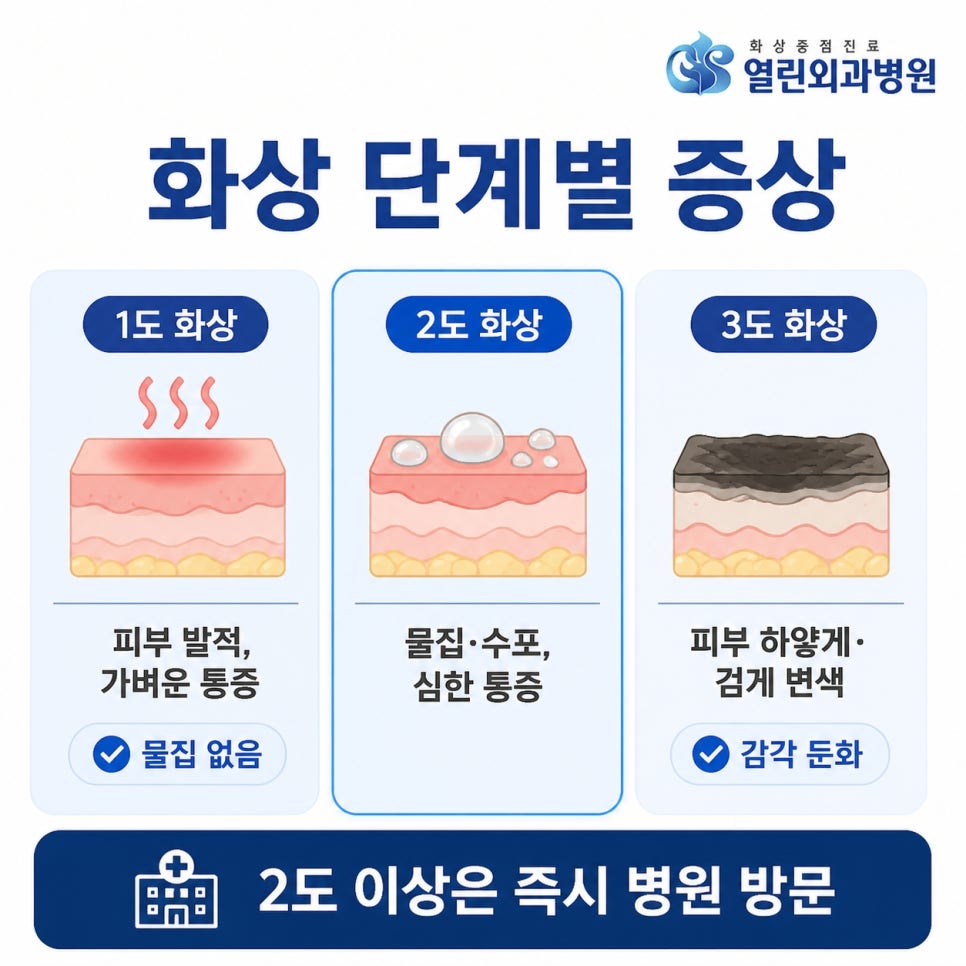
    Type Depth of Damage Main Symptoms
    First-degree burn Epidermis (outer layer) Redness, mild pain, no blistering
    Second-degree burn Dermis Blistering, severe pain, infection risk
    Third-degree burn Subcutaneous fat layer White or blackened skin discoloration, reduced pain sensation

    First-degree burns affect only the outer layer of skin and tend to heal on their own within a few days, while blistering is the defining feature of second-degree burns.

    Third-degree burns can damage nerves so severely that pain sensation may actually be reduced, which is why surgical evaluation is essential.

    Burn first aid illustration 7

    Checklist
    ✅ Is the skin red and still warm to the touch? (Possibly first-degree)
    ✅ Have blisters formed with clear or yellowish fluid? (Possibly second-degree)
    ✅ Is sensation reduced, or has the skin turned white? (Possibly third-degree)
    ✅ Is the face, hands, feet, a joint, or a large area affected? (Seek care immediately)

    How Does the Hospital Treat Burn Wounds?

    The goal of surgical treatment is to prevent secondary infection and help minimize scarring.
    Wound care refers to the full process of disinfection, dressing, and maintaining a moist environment to support skin regeneration.

    In the early stage, disinfection and specialized dressing materials help keep out contaminants, and if a blister is large, medical staff drain only the fluid using sterilized instruments.

    Trying to do this at home on your own can sometimes make an infection worse.
    Professional wound care, such as that offered near Gojan Station at Yeollin Surgical Hospital, is generally recommended for this reason.

    Burn first aid illustration 8

    After initial care, a customized moist foam dressing is applied to absorb fluid and protect the wound.

    While the skin regenerates, ongoing disinfection and monitoring alongside it may help reduce the likelihood of scarring.

    Burn first aid illustration 9

    Key Points
    1. Blisters act as a natural protective barrier — don’t pop them yourself
    2. Keep water from getting directly on the dressed area
    3. Avoid scratching, even if the healing skin feels itchy
    4. Keep using sunscreen after treatment to help prevent discoloration

    Scar Prevention and Choosing a Hospital: What to Check

    Reducing the risk of scarring is generally understood to involve preventing early infection and maintaining a moist wound environment.
    Even after the skin finishes regenerating, thorough sun protection for 3–6 months can help prevent discoloration.

    Burn first aid illustration 12

    Takeaways
    · Proper initial cooling and disinfection may help reduce the risk of scarring
    · Consistently maintaining a moist dressing may help support the pace of skin regeneration
    · Keeping up sun protection after treatment can help prevent discoloration

    If you have a second-degree burn or worse — one with blistering or skin discoloration — or a burn on the face, hands, feet, or a joint, you should see a doctor without delay.

    Ansan Yeollin Surgical Hospital is located near Gojan Station (376 Hwarang-ro, Danwon-gu, Ansan-si, Gyeonggi-do) and also provides emergency care, allowing for prompt visits even in sudden situations.

    Burn first aid illustration 13

    If you’d like information on surgical conditions beyond burns,
    check out the Burn Treatment Information, [Ansan Yeollin Surgical Hospital] Home page.


    Burn first aid illustration 11

    Frequently Asked Questions

    1. Can I apply petroleum jelly or ointment to a burn right away?
    Applying petroleum jelly or other oil-based ointments while the area is still hot can trap heat inside and make the wound deeper. Cool the burn first, then get professional disinfection and care.

    2. Should I just leave a blister alone?
    Small blisters protect the tissue underneath, so it’s best not to pop them. However, if a blister is large or very painful, it’s safer to have medical staff drain it with sterilized instruments.

    3. What can I do to help prevent a burn scar?

    It’s important to prevent early infection and keep the wound in a moist environment rather than letting it dry out. Even after healing, thorough sun protection for 3–6 months can help prevent discoloration.

    4. When should I visit a hospital after first aid?
    Second-degree burns or worse with blistering or skin discoloration, and burns on the face, hands, feet, or joints, need prompt surgical evaluation. Getting the wound checked early at a nearby facility, such as Yeollin Surgical Hospital near Gojan Station, is a good idea.


    References

    · Korea Disease Control and Prevention Agency, “Burns,” National Health Information Portal. View source (publication year to be confirmed)
    · Asan Medical Center Newsroom, “Don’t Use Ice on a Burn,” Asan Medical Center. View source (publication year to be confirmed)


    This article is intended for general health information purposes only and is not a substitute for individual diagnosis or treatment. If you have symptoms, please consult a physician.

  • Hyperbaric Oxygen Therapy for Burns: Why the 24-48 Hour Golden Window Matters

    Hyperbaric Oxygen Therapy for Burns: Why the 24-48 Hour Golden Window Matters

    SummaryHere’s what you need to know about hyperbaric oxygen therapy for burns: how it works, why the 24-48 hour golden window matters, what the treatment process looks like, and a checklist to help you prepare.

    If a burn from hot water or fire hasn’t even started to scab over after a week,
    it may be more than just a slow recovery.

    In many cases, the underlying issue is reduced blood flow to the damaged tissue, which cuts off its oxygen supply.
    One approach that’s drawn attention for speeding up recovery in these situations is hyperbaric oxygen therapy for burns.

    💡 Quick preview
    This article breaks down how hyperbaric oxygen therapy for burns works, why the golden window matters for recovery, and what to check before starting treatment.
    Read on for the 3 mechanisms that help reduce swelling and lower scarring risk, plus why the 24-48 hour window is so critical.

    hyperbaric oxygen therapy for burns

    What Is Hyperbaric Oxygen Therapy for Burns?

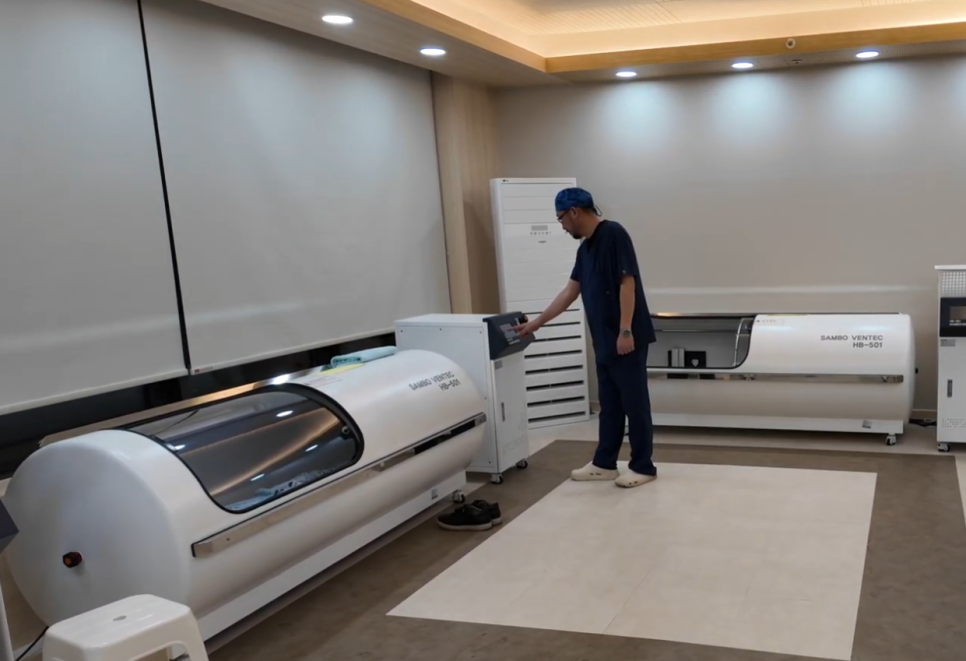
    Hyperbaric oxygen therapy for burns is a treatment in which patients breathe highly concentrated oxygen in an environment with air pressure higher than normal atmospheric pressure, in order to support the recovery of damaged tissue.
    It’s administered inside a sealed piece of equipment called a hyperbaric chamber.

    Under normal breathing conditions, oxygen struggles to reach deep into damaged skin tissue.
    When pressure is increased, however, oxygen dissolves not only into red blood cells but also into blood plasma (serum).

    If this is your first time hearing about the concept, you’re probably wondering how much it actually helps with skin recovery.
    The key idea is that it delivers oxygen directly to injured areas where circulation is compromised.

    hyperbaric oxygen therapy for burns illustration 3

    💡 Key point
    The high-concentration oxygen inhaled under pressure travels through the bloodstream deep into damaged skin, helping to lay the groundwork for cell regeneration.

    hyperbaric oxygen therapy for burns illustration 4


    What Are the Core Mechanisms Behind Faster Recovery?

    Hyperbaric oxygen therapy supports recovery through three main mechanisms: reducing swelling, promoting new blood vessel formation, and supporting white blood cell function.
    When skin tissue is damaged, localized swelling develops and blood flow drops sharply.

    If this state continues, tissue oxygen levels fall further and recovery slows down.
    High-concentration oxygen helps stimulate the formation of new microvessels, allowing fresh blood supply to return to the area.

    hyperbaric oxygen therapy for burns illustration 5

    Elevated blood oxygen levels help reduce swelling
    and support the bactericidal function of white blood cells, which can help guard against secondary infection.

    Together, these combined effects help activate the skin’s regeneration cycle,
    which may in turn help lower the likelihood of scarring.

    🚀 Potential benefits
    ✅ Reduced swelling and improved blood flow at the injury site
    ✅ Support for white blood cell function that may help prevent infection
    ✅ Encouragement of new microvessel and skin cell formation

    Why Does the 24-48 Hour Golden Window Matter So Much?

    The “golden window” in burn care refers to the first 24 to 48 hours after injury, a period that’s understood to help minimize cell death and support the body’s recovery capacity.
    The faster the initial response, the more the extent of damage may be limited.

    hyperbaric oxygen therapy for burns illustration 6

    Prompt, appropriate first aid and care during this period is understood to have a positive effect on outcomes.
    That said, this timeframe reflects general clinical guidance for burn injuries
    and isn’t an absolute standard that applies identically to every patient.

    Missing the golden window raises the risk of deeper tissue damage,
    so it’s advisable to seek a professional evaluation and prompt care immediately after injury.

    ⚠️ A note of caution
    Simply waiting for natural healing without intervention can allow the area of tissue death to expand, so it’s best to get appropriate care within the initial golden window.

    What Does the Hyperbaric Oxygen Treatment Process Look Like?

    Hyperbaric oxygen therapy generally follows this sequence: consultation and evaluation → entering the chamber → progress check.
    Understanding these steps ahead of time can help you receive care safely.

    1. Consultation and evaluation: Medical staff assess the patient’s condition and determine whether the treatment is appropriate.
    2. Entering the chamber: Pressure is raised gradually while the patient breathes high-concentration oxygen for 60 to 90 minutes.
    3. Progress check: Skin recovery is evaluated and the number of remaining sessions is adjusted accordingly.

    hyperbaric oxygen therapy for burns illustration 7

    📋 Checklist
    ✅ Does the facility have equipment that meets recognized safety standards?
    ✅ Is the treatment supervised by qualified medical staff?
    ✅ Were you given clear instructions on equalizing (ear pressure adjustment) before treatment?

    If you’re looking for a specialized hospital that offers hyperbaric oxygen therapy,
    the homepage of Ansan Yeorin Surgery Hospital, a hospital specializing in burn treatment, is a good place to find more information.

    hyperbaric oxygen therapy for burns illustration 8


    Frequently Asked Questions

    1. Is the treatment painful or uncomfortable?
    As pressure increases, you may feel ear fullness similar to what you experience on an airplane. Swallowing or pinching your nose while gently blowing (equalizing) usually resolves this.

    2. How long does each session take, and how many sessions are needed?
    A single session typically takes 60 to 90 minutes, and the total number of sessions varies depending on the severity of the burn and how recovery progresses.

    3. Can it be combined with regular wound dressing?
    Yes. When combined with standard wound care and dressing, it may support skin regeneration alongside those treatments.

    4. Can every burn patient receive this treatment?
    Eligibility depends on the depth and extent of the burn as well as overall health, so it should be decided based on a physician’s evaluation.

    5. Does it completely eliminate scarring after treatment?
    It may help lower the risk of scarring, but results vary by individual and complete scar removal isn’t guaranteed.

    hyperbaric oxygen therapy for burns illustration 9

    hyperbaric oxygen therapy for burns illustration 10

    If you need emergency burn care in the Ansan area, it’s worth checking in advance whether a hospital has dedicated burn specialists and the proper dressing materials on hand.
    Facilities like Yeorin Surgery Hospital, located at 376 Hwarang-ro, Danwon-gu, Ansan-si, Gyeonggi-do, can serve as a reference for the kind of care infrastructure to look for.

    hyperbaric oxygen therapy for burns illustration 11


    References

    · NCBI StatPearls, “Hyperbaric Treatment of Thermal Burns,” StatPearls Publishing, 2023. View source
    · Journal of Burn Care & Research, “Hyperbaric Oxygen Therapy in Burn Care: A Systematic Review of Current Evidence,” Oxford University Press, 2025. View source
    · Doctors News, “Why Is Hyperbaric Oxygen Therapy Needed for Acute Burns?”, Korean Medical Association, 2023. View source


    This article is intended for general health information purposes only and is not a substitute for individual diagnosis or treatment. If you have symptoms, please consult a physician.